

Updated November 25, 2026. A pre-launch guide using iRacing’s current VR tools and Pimax’s published product specifications.
iRacing Career Mode is scheduled for December 2026. If that has you planning a return to the cockpit, choose a VR setup around the way you race: the dashboard you need to read, the view you want through a corner, and the headset you want to wear through a session.
Our four options cover different priorities. Crystal Light offers glass aspheric lenses in a full-size PCVR headset. Crystal Super adds optical-engine choices. Dream Air and Dream Air SE bring micro-OLED displays to a compact design. Start with your priority below, then check the requirements of the model you choose.
Choose a Pimax headset by your racing priority
- Crystal Light: Start here for a full-size headset with glass aspheric lenses.
- Crystal Super: Compare pixel density and field of view across QLED optical engines.
- Dream Air: Choose compact micro-OLED with the higher panel resolution of the Dream Air pair.
- Dream Air SE: Compare a lighter micro-OLED option and its current package price.
Each product link opens the available configurations and current pricing.
What the Career Mode announcement means for your setup
In its November 18 announcement, iRacing confirmed a December 2026 launch plan and inclusion with membership. Seven disciplines provide different career paths. Cars and tracks in your Career Mode season are available within that experience, including content you have not separately licensed for other modes. Race length and difficulty can be adjusted.
That makes this a useful time to prepare your seat and controls. The announcement does not provide a precise release day or Career Mode-specific VR benchmarks. Establish a working setup in the current simulator and revisit the launch notes when the mode arrives.
Compare the four Pimax options
| Headset | Published display specification | Your main comparison |
|---|---|---|
| Crystal Light | 2880 by 2880 per eye; glass aspheric lenses | Full-size headset, manual IPD, no eye tracking |
| Crystal Super | QLED: 3840 by 3840 per eye | 50 PPD, 57 PPD or Ultrawide optics |
| Dream Air | Sony micro-OLED: 3840 by 3552 per eye | Higher panel resolution within the Dream Air pair |
| Dream Air SE | Micro-OLED: 2560 by 2560 per eye | Lower published headset weight within the pair |
Panel specifications guide the comparison. Your PC, render settings and tracking package determine the setup you can use. The product sections below link to the specification sources and purchase options.
Pimax Crystal Light
A first shortlist for a full-size PCVR cockpit
Start with Crystal Light if you want a dedicated PCVR headset with glass aspheric lenses. Its 2880 by 2880 pixels per eye give you a concrete specification to compare with your current headset. The large lens sweet spot is relevant when checking gauges and mirrors from your driving position.

- Choose among 72Hz, 90Hz and 120Hz settings to match your testing plan.
- Set the manual IPD adjustment within its published 58–72mm range.
Crystal Light does not support eye tracking. If eye-tracked rendering is a requirement for your setup, include Crystal Super or the Dream Air series in your comparison.
View Crystal Light pricing and options
Pimax Crystal Super
Choose an optical engine around detail or field of view
Crystal Super gives you a choice of QLED optical engines. The 50 PPD, 57 PPD and Ultrawide options each list 3840 by 3840 pixels per eye. The difference worth comparing for a cockpit is how pixel density and horizontal field of view fit your priorities.
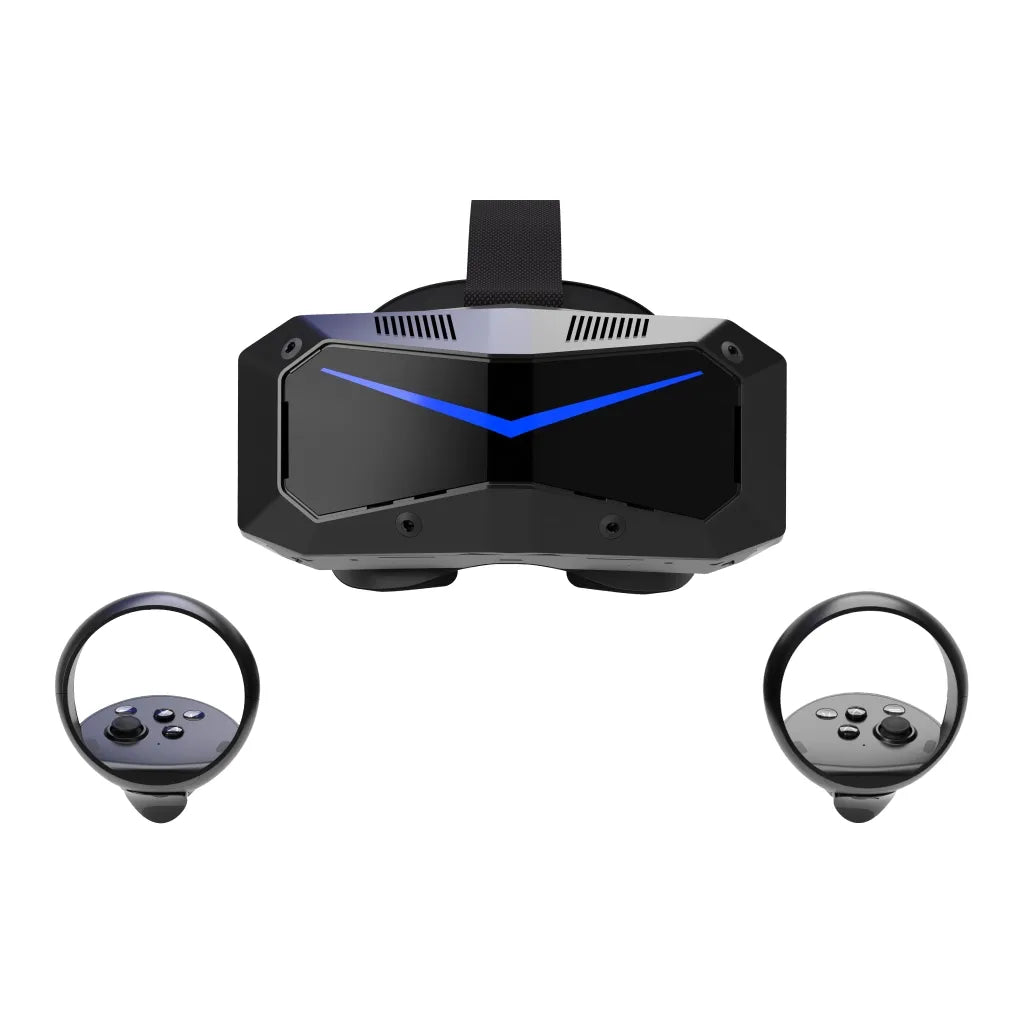
- 50 PPD lists 127° horizontal FOV; 57 PPD lists 106° for a denser central view.
- Ultrawide lists 140° horizontal FOV. Eye tracking and automatic IPD adjustment are supported.
Prioritize the 57 PPD option for density, or compare 50 PPD and Ultrawide when peripheral coverage matters more. These figures describe the QLED options linked here; the separate 8K Micro-OLED version has different specifications.
Compare Crystal Super optical engines
Pimax Dream Air
High-resolution micro-OLED in a compact headset
Shortlist Dream Air if you want a compact micro-OLED headset for your racing seat. It uses Sony micro-OLED panels with 3840 by 3552 pixels per eye. Pimax publishes a headset weight below 170 grams, which makes it worth considering when headset bulk is part of your upgrade decision.

- Eye tracking is included for a compatible eye-tracked rendering setup.
- Choose SLAM tracking or a Lighthouse version to match the equipment around your rig.
The SLAM version works without base stations. The Lighthouse version requires compatible base stations. Choose the actual package before comparing cost; the published headset weight is not the weight of every accessory you may wear or attach.
Choose your Dream Air configuration
Pimax Dream Air SE
A lighter micro-OLED alternative to compare with Dream Air
Dream Air SE keeps the compact micro-OLED approach and lists a headset weight below 140 grams. Its panels are 2560 by 2560 pixels per eye. Compare it with Dream Air if a lighter headset and the complete purchase price matter more to you than the higher panel resolution of Dream Air.

- Eye tracking is included; check the rendering path supported by your software.
- SLAM and Lighthouse versions let you choose around your existing tracking equipment.
Use the two models’ current product pages to compare the price of the tracking packages you actually need. Panel resolution alone does not establish iRacing frame rate. Published headset weights exclude a complete accessory setup.
View Dream Air SE packages and pricing
Product photographs are official Pimax assets. The Dream Air series images show SLAM bundles with controllers. Package contents vary with the version selected on the product page.
Check your PC and tracking before ordering
Match your computer to both the current iRacing requirements and the requirements on your chosen headset’s product page. Note your CPU, GPU, memory and available display connections. For a laptop, confirm how its display outputs connect to the graphics hardware.
For Dream Air and Dream Air SE, select SLAM if you want headset tracking without base stations. Select Lighthouse around compatible base stations you own or plan to buy. Compare included controllers and required accessories before checking out.
Eye tracking is a hardware feature. Any rendering benefit also depends on the application, runtime and settings. We do not have Career Mode-specific performance results to use as a purchase guarantee.
Prepare the cockpit with a repeatable VR test
Follow iRacing’s VR setup instructions. Confirm that your headset works in Pimax Play, then use Test Drive with a familiar car and track. Record the runtime, render resolution and refresh rate so you can repeat the session.
- Check the dashboard from your normal seating position.
- Turn toward mirrors and corner exits to check fit and view.
- Test conditions that resemble the races you normally enter.
- Confirm your wheel and pedals, cable routing and accessible recenter control.
Follow the current runtime guidance. iRacing recommends removing the discontinued OpenXR Toolkit. OpenXR itself is a separate runtime standard. Use the seated-view instructions to map Recenter VR View to a reachable button.
Before you choose your configuration
Do I need VR controllers to steer?
Your wheel and pedals handle driving. VR controllers serve separate setup, menu or other VR application needs. Check the contents and setup instructions for the selected bundle.
Should I choose Dream Air or Dream Air SE?
Use the comparison above to decide how much panel resolution you want, then compare the two complete packages for your tracking setup. Fit and your available PC performance also matter.
Will an upgrade give me a particular frame rate?
A frame-rate target needs testing with your own hardware and race conditions. Save a baseline before changing settings, and review the Career Mode launch guidance when it is available.
Choose the headset for your next racing setup
Open the model that matches your priority. Select its tracking or optical configuration, then check the current price, delivery estimate and return terms for your country.


